


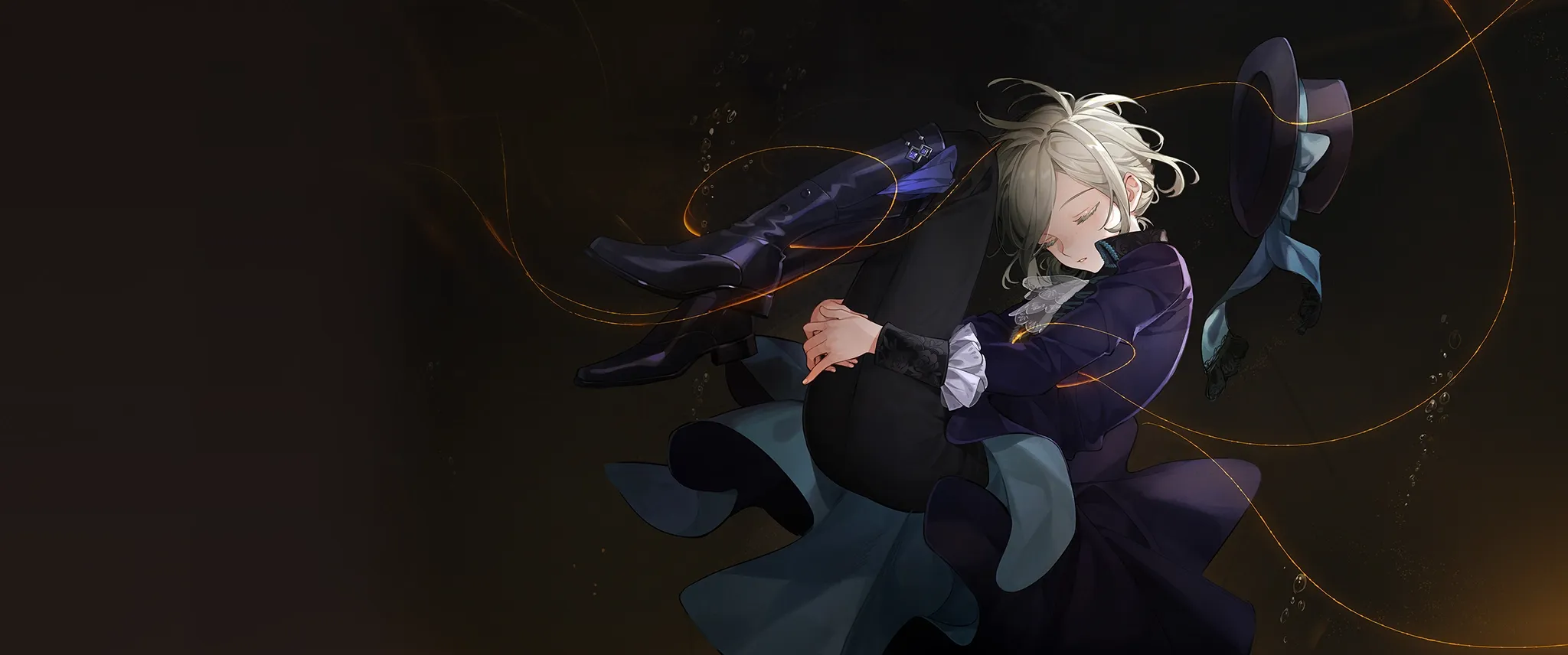
Jailer: Ladies, I must apologize for what happened back there.
Jailer: We were caught off guard. There has never been a commotion of that scale before. I must report this to the Physician.
Vertin: Don't worry, Ms. Jailer. We made it out in one piece.
Jailer: Thank you for your understanding. Ordinarily, I would arrange to escort you to a safer location, but I'm afraid at this hour, you'll have missed the last train. And the roads are icy at night.
Hearing this, Recoleta exchanges a quick but meaningful expression with her companions.
Recoleta: Psst, Vertin. We can't leave like this.
Vertin: We appreciate your kind consideration, Ms. Jailer, but we still have some unfinished business here.
Jailer: I see. I'll arrange a clean room in a safer section for you.
Jailer: We'll do our best to ensure your safety tonight.
Night falls as the girls huddle together, scrutinizing their unfamiliar surroundings.
Sonetto: They actually found us a spare room.
Recoleta: Bleak, quiet, and somber. It's a cell like all the others.
Vertin: Don't worry. This isn't the first time we've ended up on the wrong side of the bars.
Sonetto: At least this time we're just here for the night, not a full sentence.
Sonetto lets out a whisper-thin protest.
Vertin: Though, this cell is quite different from the ones we've been in before.
Recoleta: Not just this cell. The whole prison is unlike anything I've seen.
Recoleta: And this society they've been running here isn't some mere pastime. They're having real discussions about meaningful topics, even though the rest of the world has been cut off from them.
Sonetto: But we're still in an arcanist prison, a place where conflicts and violence can erupt at any moment. Let's not forget that.
Sonetto: Ms. Jailer warned us from the start. These prisoners are mentally unstable and potentially dangerous.
Sonetto: Ms. Recoleta, with all due respect, we can't afford to see this place through rose-colored glasses. We'd be overlooking the risks, as we did earlier.
Recoleta: And with all due respect, Sonetto, we didn't overlook any danger. At least I didn't. A writer must be observant if she is to accurately reflect the world in her writing.
Sonetto: But you—
Vertin: We came here with different goals, and still, none of them have been accomplished.
Vertin: I suggest we focus on our respective missions instead of fighting with one another.
Sonetto: Apologies, Timekeeper. Ms. Recoleta, I take back everything I said.
Recoleta: Don't apologize, Sonetto. I'm at fault, too. Sometimes I forget that words can be as sharp as swords. You were only thinking about our safety. I shouldn't have been so rude.
Recoleta: I actually really admire how you fought back there! If you'd allow me, I'd like to write a poem for you, once my novel's finished.
Sonetto: Ah ...
Vertin: That's terribly kind of you. But honestly, I think we've had enough poetry today to last a lifetime.
Recoleta: Let me know if you change your mind. By the way, did either of you see what happened to the Idealist?
Recalling their recent conflict, the indomitable girl finally hesitates.
Vertin: The jailer told me she went back to the gallery once everything calmed down.
Vertin: She found nothing: no blood, no shell cases, not even a trace of the Idealist.
Sonetto: Timekeeper, now's really not the time for ghost stories.
Recoleta: Do you mean that maybe the Idealist somehow managed to get out of there on his own?
Recoleta: Or perhaps someone else helped him.
Vertin: Well, according to the Idealist and our jailer, any inmates who are unwell will be taken to the Physician.
Vertin: It's possible someone brought him there while everyone else was shouting and running about.
Recoleta: You're right. It could be that he's with the Physician right now. I'm relieved! That was a sudden plot twist, but a visionary of his magnitude doesn't deserve to die in silence like that.
Vertin: To be fair, the gunshot was quite loud, as was the ensuing commotion.
Recoleta: ...
Recoleta: Nonetheless, he couldn't have just died like that! I mean, the readers would riot if a writer were to kill off a character so abruptly!
Recoleta: But, you believe he's still alive, too. Am I right?
She knows her words are merely a cover. She needs an answer—a real, undeniable answer.
Vertin: There's nothing that we can be certain of for now. But on a brighter note, we didn't come back empty-handed from our mission either, Sonetto.
Vertin: We found Dr. Dores's signature in the gallery. You were right all along, Recoleta. She was here.
Sonetto: But we didn't see her at the gathering. Could something have happened to her, like with the Idealist?
Recoleta: Do you think she was also sent to the Physician and never made it back?
Vertin: This is all just speculation. If we want to find the Idealist or Dr. Dores ...
Vertin: We need to speak to this Physician first.
Vertin: Ms. Recoleta, do you believe that the Idealist could be your pen pal, Aleph?
Recoleta: Whether he is or not, he's still my best lead.
That name touches a nerve once again.
Recoleta: Friends, I've had this strange feeling in my gut since we got here. Something is slowing us down.
Recoleta: Now to figure out what it is ...
A silent fear grips her, like ripples suddenly appearing on a once-still lake, unsettling in its quiet disturbance.
Recoleta: Look, it's a wild guess, but just wait till I finish.
Recoleta: It feels like everything happening in this prison is somehow connected to my novel, The Rise and Fall of Sanity.
Vertin: We're no strangers to wild guesses, and sometimes they're closer to the truth than you'd think. So this ...
Recoleta: The Rise and Fall of Sanity.
Vertin: Sorry. What exactly is your story about?
The question scatters the midnight gloom. Outside, moonlight spills over gray-white snow.
Recoleta: Hah! I never thought that you'd be interested!
Recoleta: It starts—sorry, it's been a while since I told it from the beginning: A few, a few years ago, I worked, worked as a forest ranger. It happened in a desert town called Amalfitano, in Sonora back in 1975 ...
Two patient listeners watch the stammering girl, waiting for the next part of her story.
Recoleta: Ah, you know what? Most people say the beginning's a bit hard to get into, except for Aleph. I'm thinking of rewriting it.
Recoleta: But if you like the sound of it so far, maybe I could read you the latest part I just finished?
She studies her readers' expressions, guessing madly at their responses.
Vertin: Please.
Recoleta: "It all started with the frequency data from the tapes."
Recoleta: "The general pattern seemed to have changed. At first, the Paracausality Researcher chalked it up to a statistical error—a glitch, perhaps."—Oh, sorry.
Recoleta: But after a few days and long nights of meticulous calculations, that explanation only became less and less plausible. The odds of success and failure kept shifting, and the chance of repeating the previous result kept growing. It was as if someone had tampered with the rules and tweaked it to their liking.
Recoleta: She took her findings to Amalfitano, "the town of nothing," as they called it then.
Recoleta: Near the old looms, she met a blind weaver who spoke softly of an old tale:
Recoleta: "I heard a strange rustling at dawn, like a die rolling along a wooden floor. Then the morning light dimmed and died. That was the last time I saw the sun, my own hands, or the threads I worked with."
Recoleta: "The second time I heard the die roll, I was told the oxen in the field sank to their knees and never stood again."
Recoleta: "By the third roll, the fields were crawling with frogs. Plows ran over them, and some still writhed, squeezing themselves deeper into the cracks in the earth."
Recoleta: "The fourth time the die rolled, ten dormice plunged into the sea in a strange sleepwalk, and ten bears feasted for the last time before winter arrived."
Recoleta: "The final roll of the die was cast in a cage, during a duel, before a crowd of eager eyes. The winner left with ten pounds of gold, and the loser left with ten flies which fell on him to feast."
Vertin: ...
Sonetto: ...
The quiet spreads through their cell like a rolling tide.
Vertin: Is that all?
Sonetto: Emm. Seems like it.
Recoleta: Well, there's more, but I haven't quite figured those parts out yet.
Recoleta: Any thoughts? Anything? I can take it. Please. I really need some feedback.
Vertin: I ... I wonder if the protagonist ever finds this "Die of Babylon" in the end.
Recoleta: Oh, Vertin, it isn't a real die. It's just a metaphor!
Vertin: Oh, I see. I must've missed that. Sorry. Still, it's a beautiful story. Sad, but beautiful.
Recoleta: The story is still too obscure, isn't it? sigh Aleph warned me about this. In our last correspondence, he suggested adding the Blind Weaver to shed light on the hidden theme.
Recoleta: It helped at first. But even with this sage advice, no matter how hard I tried, the plot just didn't seem to move forward.
Recoleta: I feel stuck in that village with them—lost, dazed, isolated inside their small, disconnected moments. Something crucial is missing, leaving gaps between the characters and scenes.
Recoleta: Should I change the storyteller's perspective? Start a different angle? Or maybe rewrite the characters completely? What should I do?
Before the writer sinks into a swirling vortex of self-doubt, someone decides to push for something tangible.
Sonetto: Apologies, but you said your story somehow connects to what's happening here in the Panopticon. What makes you think that?
Recoleta: It's a strange feeling. Like everything here belongs to a dream I once had, only I can't remember it.
Sonetto: Do you mean that you have a sense of déjà vu?
Sonetto: It's nothing to worry about. Our psychiatrist friend, Kakania, told me those moments are often the result of a dysfunctional connection between two parts of the brain, like a little glitch in our heads.
Recoleta: No, it's nothing like déjà vu!
The storyteller snaps back, politely agitated.
Recoleta: Déjà vu is a single moment, a specific situation. But here it's everything! La Sociedad, the rules, the Idealist, even the incidents in the gallery! Each one unfolds in a similar pattern, like the grooves on a record, telling a story I feel I've listened to before.
Recoleta: Amalfitano and Comala. They're two sides of that same record, playing out the same tune. Whatever happens in my story seems to be happening here too.
Recoleta: I had that feeling when I met you as well, Ms. Vertin.
Recoleta: At first, I thought it was only an interesting coincidence. You're much like the first character in my story—a traveler with a suitcase.
The girl rambles on, desperately relating to her characters.
Recoleta: But then I realized, the doctor, your Dores—she's like the Blind Weaver, who lost her sight to the die despite having always been faithful to it.
Recoleta: And the jailer—she's the Bank Clerk who assisted the corporation in taking over the town in order to escape her past.
Recoleta: And the Idealist? He's the Murdered Donkey Driver. And the Die of Babylon ... No ...
Recoleta: My dear fictional friends ... What on earth is happening to you?
Vertin: Wait. Are you saying that everyone we've met here matches a character from your story, like some kind of archetype?
Vertin: That sounds unbelievable. But, then again, maybe you're onto something.
Vertin: You see the world through a different lens that none of us share.
Recoleta: Not just the characters! The events here are mirroring my story, too.
Recoleta: Aleph—he's the only one who truly understood my story. If things are playing out just like my novel, then ...
Recoleta: Maybe Aleph is in fact still here.
Vertin: Are you suggesting that someone is controlling the Panopticon in order to make it follow the same plot as your story?
Vertin: That they've set the rules, started the poetry group, planned the attack on the Idealist, and tried to prevent us from finding Dr. Dores?
Vertin: If that's true, Ms. Recoleta, it's very likely that the one acting against us is in fact Aleph himself.
Recoleta never expected the chain of reasoning to unravel this way.
Recoleta: But I ... No ... How could that be possible?!
She interrupts, only for confusion to creep onto her face moments later.
Recoleta: Why? Why would he do this?
Recoleta: I don't see any reason why he'd be connected. He's an intelligent, cultured, and profound person, not a common killer.
Recoleta: No, none of this adds up.
Sonetto: Remember, Dr. Dores was brought to Ushuaia by the Zeno rebels.
Sonetto: And we know they're connected to Manus Vindictae.
Sonetto: If this Aleph really is hiding Dores from us, he may be working with them.
Recoleta stares blankly for a time before clumsily shifting the topic.
Recoleta: Oh my, Sonetto! I didn't know you had such a flair for stories! Maybe you should join us and become a visceral realist too.
Recoleta: I think you're only imagining things. Perhaps you were inspired by this strange prison? Haha.
Vertin: Perhaps we all need to start writing our own stories.
Vertin: Come out, now. Whoever's out there, speak up.
Vertin: How can we help you?
Sonetto: Who's there?
COMBAT