

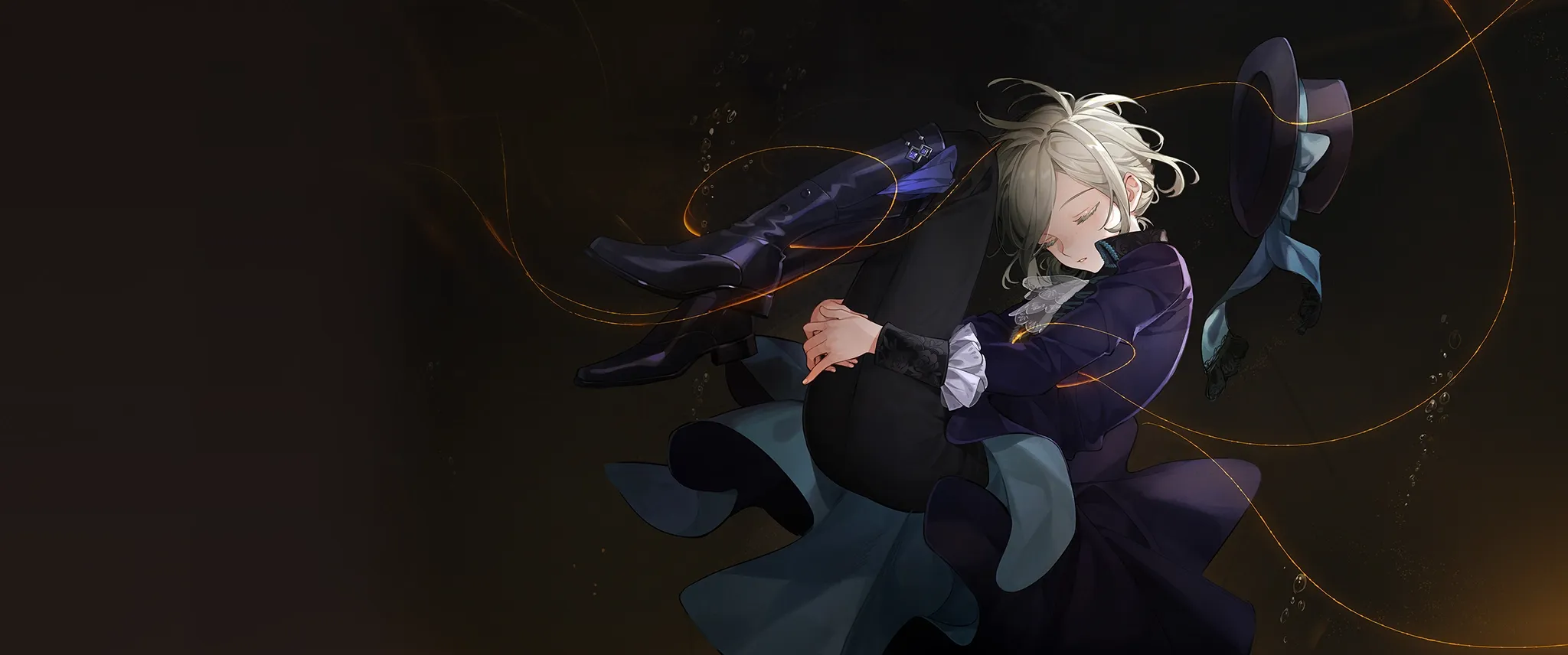
Kakania: Feeling better now? Is anything still haunting you, talking to you?
Kakania: Do you remember who you are, Isolde?
The clinic returns to silence as Kakania holds Isolde's hand, observing with concern the pale actress before her.
She looks toward the tabletop mirror, allowing tears to fall from her hollow eyes.
Isolde: Oh, yes, doctor. I see it now.
Isolde: That fire, the fire that devoured everything! How could I ever forget?
Isolde: The raging fire consumed everything, including Theophil. He was screaming—his mind was already gone before he ignited it all.
Isolde: How could he ignore everything with such disregard? Who allowed him to forget with such disregard?
Isolde: While I remember, I remember it all. I'm from a noble family, I need to be a qualified Dittarsdorf, an outstanding arcanist, a first-rate opera singer, a good sister, and a good daughter ...
Isolde: Never forget my manners, never forget the family!
Isolde: But he—he got away with it! If Theophil was truly a man of courage, he should've joined the army, or fought a duel with someone—that would've made his death more honorable!
Isolde: Yet, he chose to die this way, after a life of debauchery.
She breathes a heavy and bitter sigh, and finally, color returns to her face.
Isolde: sobs I'm sorry ... I shouldn't have told you that.
Kakania: It's okay, Isolde, you're doing it right. That's what therapy is for.
Kakania: These memories are exactly what we need. What's been deliberately repressed and ignored in the depths of your heart will manifest into words, and help you reconnect with your emotions. Soon your symptoms of hysteria will diminish!
Kakania: Don't be afraid. You can talk to me about anything. In the name of my family and the Hippocratic Oath, I will keep things between you and me.
Kakania: Everything will be a secret, our secret.
Isolde: Our secret ...
The woman's cheeks, still wet with tears, reveal a tragic smile, like dew on rose petals.
Isolde: Sounds wonderful.
Isolde: ...
She closes her eyes, striving in that moment to open them without being free from the fog of the past.
Isolde: I remember that room.
Isolde: The room was excessively bright. I never got used to light bulbs, preferring the softer light of candles. My mother always had a white candle burning when she saw me at bedtime.
Kakania: What happened to that candle?
Isolde: Someone knocked it over. Ha! That naughty brat, my dark-haired brother!
Isolde: He lit the candle, set the room on fire, and burned all his paintings!
Isolde: He ran to me, his body burning! In his hand was ...
Isolde: A gun.
Isolde: I once told Theophil, he's not a genius like Weininger. Biting the bullet won't make him famous. Only a debut leaves an impression, the shows that follow are boring repetitions.
Isolde: He laughed. "Indeed. Too many have shot themselves for fame. Only through passionate fire would the world remember me."
Isolde: I bid him farewell, and went downstairs to talk to the ladies. Blood soaked the wooden floor and dripped into my cup. Plop, plop, plop. I went upstairs and found Theophil lying in a pool of blood.
Isolde: A revolver was in his hand. Ah, how its cylinder clicked like music.
Isolde: I lifted my dress so the fire could roll down like water. I leaned over to the hole on his left temple and said, "Theophil, where is your fire?"
Isolde: Theophil sat up, and said, "Isolde, where's your gun?"
Kakania: "Your gun?"
Isolde: ... My gun?
Her voice trailed out into a low sinister growl.
Isolde swoons toward her reflection in the mirror, her hand raised high as if delivering a monologue on stage.
Isolde: My gun! I remember now, I was holding the gun all along!
Isolde: Theophil stood in the study. The flames engulfed the beam, the ceiling, everything.
Kakania: What?!
Kakania speaks as softly as possible despite her shock, with the intent not to disturb the woman's soliloquy.
Isolde: He ran toward me, screaming, in pain. He was burning, the heat drying up my eyes ...
The woman begins to shake under the weight of revelation.
Isolde: He was on fire, and running towards me. Doctor, he ran at me!
She clenches her teeth, trying to squeeze out words, gripping her chest as if to squeeze out her insides—to open herself like a finely crafted wooden box, offering herself to her rescuer.
Kakania: Breathe in, breathe out ... It's okay, Isolde. I'm here by your side. You're safe.
Kakania extends her arms, gently encircling the woman into her embrace.
She breathes deeply, calming down inside the green warmth.
Isolde: And then, I heard a shot.
Kakania: ...
Their embrace tightens slightly.
Isolde: I-I can't remember ... The trigger was hard to pull. After the shot, it slipped out of my hand ...
She lifts her head up towards the good doctor, tears flowing from her eyes.
Kakania: ...
Isolde: I killed Theophil! It was me!
Isolde: I don't deserve the right to attend his funeral, or to hold his memorial art exhibit. I don't deserve any of the sympathy and kindness ...
Isolde: I should have burned in that fire, I should have died! sobbing
Kakania: It's fine.
Isolde: ...?
Kakania: I'm neither judge nor police, Isolde. I'm just your doctor. I'll remain faithful to you, no matter what you think you are.
Kakania: Your life was in danger. Anyone would've done the same.
Kakania: It was not your fault, Isolde. You were just ... terrified.
Kakania: Don't be ashamed of your instinctive behavior. Rest assured, your secret is safe with me.
Kakania: According to Dr. Freud, embracing your darkness is the first step to liberation.
Kakania: It takes courage, and is not easy to do. Most people can't do it, but you've done a very good job.
Isolde: ...
Isolde: I did a good job?
Kakania: Yes. An excellent job.
Isolde: Doctor ...
Her tears now are like a broken dam, relieved of the burden that it had too long held.
Kakania holds her gently, waiting for her long-overdue catharsis to come to an end.
Kakania: Alright, this is as far as I can walk you. You have to host a ceremony tomorrow, and Tosca's next week. Vienna won't forgive me if I take up too much of your time.
Isolde: Don't worry about it. Like you said, the night breeze will do me some good.
She still cleaves hard to Kakania's arm, imperceptibly shaking her head.
As twilight falls, few passersby notice the distinguished opera singer among them.
Kakania: I heard from Heinrich that you're trying new things?
Kakania: I read his stage design. The style of Berlin expressionism he adopted is quite refreshing.
Kakania: I have to admit, he became a little strange after his trip to Berlin. But his passion for art didn't change, nor did his love for his fellow Viennese.
Isolde: I appreciate his hard work as well. But sadly, the Vienna Court Opera didn't approve our performance application, so we turned to the Vienna People's Opera.
Kakania: Well, I'm not surprised. Understand that Mr. Mahler is the artistic director of the Vienna Court Opera, and even he could not bring Salome to the stage.
Kakania: Those boring, stale old-timers will never approve of new forms of art. They always expect something predictable and unvarying, the same old pieces and settings.
Isolde: ...
Her complexion darkens again as she turns her head.
Isolde: I'm the reason Tosca can't get the permission.
Isolde: Because I, the star, am a medium, a maniacal "arcanist."
Kakania: Oh, no, that's not it. In Vienna, the great composers, conductors, and performers ... almost all of them have been arcanists.
Kakania: Wiping out the unique talents of arcanists and their artistic contributions would be like setting fire to the cultural tapestry of Viennese society!
Kakania: Oh, sorry. A flood! A flood is better ...
The actress is, or at least acts, oblivious to this minor slip.
Isolde: They consider it a desecration of the stage. When a singer is channeling, she's essentially asking a spirit to possess her and speak directly through her, thus she "becomes" the character in the opera ...
Isolde: People will question the authenticity of the voice—is this still the singer's own voice? Or is it fraud?
Kakania: No, Isolde. They think that, because they know nothing about performance, not even the slightest thing.
Kakania: The nature of the stage is to be someone else. If they're so intent on the presentation of the true self, the mirrors in my clinic would like a word with them.
Kakania: It is an actor's job to become another person. On stage, in a fictional world, they briefly trick our eyes into thinking it's real.
Kakania: And to achieve that, we rehearse rigorously, through sweat and pain. We take care of the music, the costumes, the settings, the lights ...
Kakania: Your gift helps you do this better than others. That's all.
Isolde: ...
Isolde: But I used the arcane skills of the Dittarsdorf family. I couldn't have done these things without them.
Isolde: What if an arcanist's talent for art is also a curse?
Isolde: Maybe I'm just a fraud, doctor. I'm propped up by my illness, and once it's cured, my talent will be gone with it ...
Kakania pauses abruptly.
She turns back, looking at an operatic genius tormented by her own talents.
Kakania: It's not like that, Isolde.
Kakania: Using your talents is not cheating.
Kakania: We're "arcanists." But before we allow ourselves to be defined by that word, who are we really?
Kakania: If an "arcanist" grew up on a lonely island, she wouldn't see herself as an "arcanist," but as a "person" like you, like me, like everyone.
Isolde: Doctor ...
Isolde meets her gaze as the stars twinkle back in Kakania's eyes.
Kakania: But you know, the truth is, when I look at a crowd, I don't see any "arcanists"!
Kakania: All I see is our people, with different talents, trapped in life, their selfhoods ground smooth until they're indistinguishable from the crowd.
Kakania: Humans celebrate their flaws, yet they persecute our gifts.
Kakania: They control the narrative. They define our gifts as diseases, our talents as weaknesses, and our bloodlines as curses.
Kakania: If we're cured, we're just another face in the crowd. But if we live on with our "diseases," we're forever ill, forever afflicted.
Kakania: We arcanists have to live in such a world, where we survive through suffering.
Isolde: ...
Kakania: Look at this city, this most enlightened, tolerant city. Under the sweet surface of the Sachertorte lies powder and poisonous wine.
Kakania: Arcanists are recognized for their artistic abilities, nothing more. We hold no parliamentary seats, no professional titles, and no professional credentials.
Kakania: We are exiled and marginalized. Our only voice in the culture is to be decoration, because decoration impacts nothing.
Kakania: The restrictions and discrimination against arcanists are worsening by day. First we had to register with the government, then we needed residence permits, and now, permission to cast arcane skills.
Kakania: And we can do nothing but tolerate, stay polite and dignified. Be a "good" arcanist, show no signs of "instability," because we're supposed to stay rational, otherwise, we're animals.
Kakania: But people are complicated, they can't stay rational forever—as Dr. Freud said, we're just seeing the tip of the iceberg.
As the streetlights come on, Kakania looks up, now resembling an actress mid-monologue beneath the stark light.
Kakania: You might be sick, I might be too. But the truth is, this whole society is sick! You can't just treat the individual and ignore the bigger picture.
Kakania: It was the repression of irrational desires that allowed the diseases to spread in our time.
Kakania: In this case, the people on that island are much freer than we are!
Isolde: You mean that mysterious island? I hear gold is in the ground there.
Kakania nods with vigor.
Kakania: Remember the lady from the Foundation?
Isolde: Yes. Why?
Kakania: She said the arcanists on that island are not lunatics, and they're living a life free of restrictions.
Kakania: Doesn't that sound great? If we could form our own society, like those artistic associations, and have control over our own production and labor.
Kakania: This must've been some kind of enlightenment. I can almost see it, they'll show us another way of life, a kingdom free of repression.
Kakania: To help them is to help ourselves. And that's also what your exhibit is about.
Isolde: Me? No, I'm not as great a person as you.
Kakania: But you are working for a great cause.
The stars in her eyes begin to spread out. Kakania reveals a deep and tender smile.
Kakania: Isolde, my friend. I've shared my dream with you, and I hope one day it'll become your own, until the day when everyone shares the same dream.
Kakania: Our society needs a revolution, a radical surgery.
Kakania: We urgently need a new vision to reunite us at the dawn of the new century.
Kakania: Like the secession in art history, we need a secession of arcanum to distinguish us from "hysterical lunatics," "street peddlers," and "con artists."
Kakania: We need a new dream, a new saga. We need to reinvent ourselves and become a new people.
Kakania: No more repression, only the full embrace of our primal desires.
Kakania concludes her monologue, removing her hat to fastidiously straighten the feathers on top.
Kakania: That's why your work has not been in vain! From Theophil's art exhibition to the promotion of new art ...
Kakania: Do not doubt yourself. You're helping a great cause.
Isolde: ...
Isolde: Thank you, doctor. This is the first time anyone's said that to me.
Isolde: I will bear that in mind.
Isolde: ... Your words in the breeze of night have been stirring. Can you walk with me a little longer?
Isolde: I'd like to hear more things about the secession you mentioned, so that I can prepare my speech for tomorrow's ceremony ...
Kakania: Yes. It is my pleasure.
Kakania: Would you like a walk to the Vienna People's Opera? I think they put up new posters.