

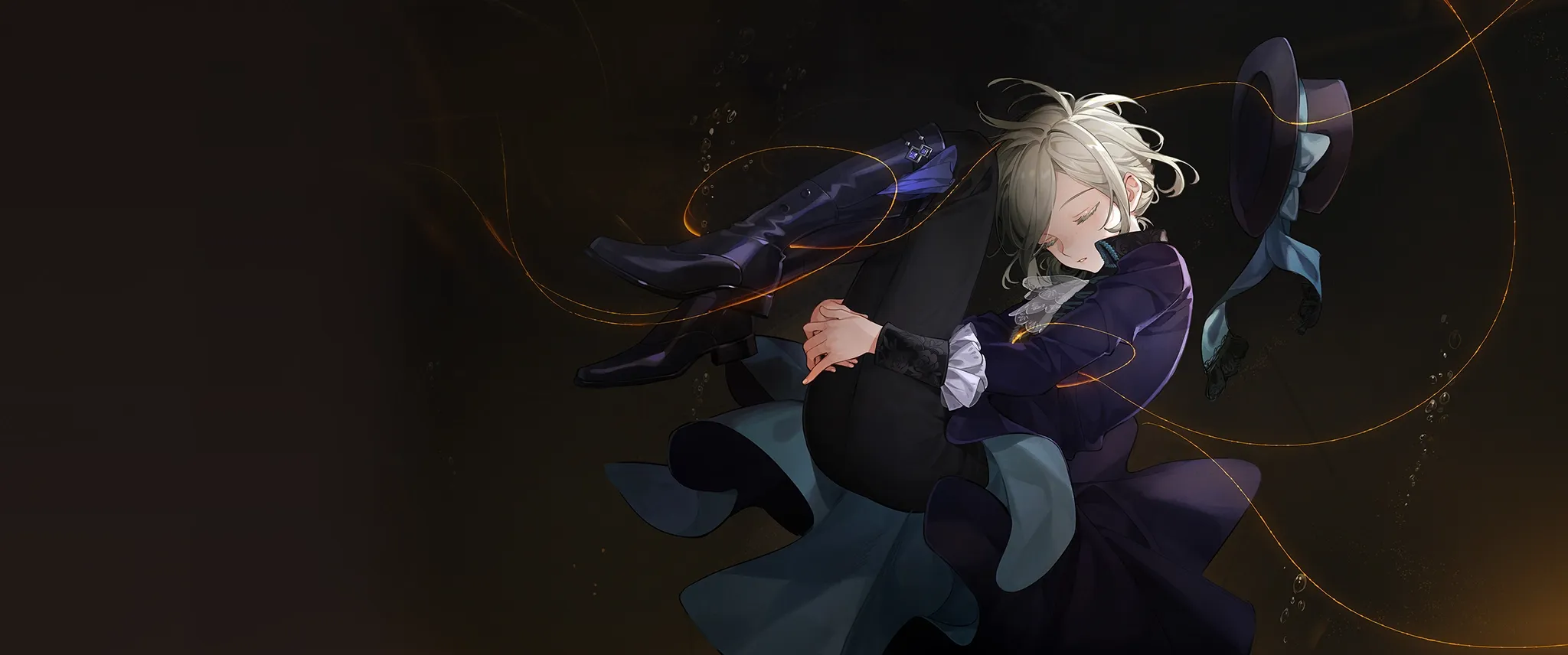
???: Yes, yes. She is Salome.
???: She's mine ...
???: My Salome. My muse.
Admirer I: Brava!
Applause.
Admirer II: Brava! Fantastic—truly fantastic!
Another Applause. Cliche. Boring.
They are merely spectators, distant observers. Their understanding of her is shallow. Of course it is.
The concept of a "seance performance" has captivated the minds of the people. The hall is filled to the rafters with a crowd eager to see the horrific dead descend on this beautiful singer with their own eyes.
Admirer III: Humph. This can't possibly be a real performance!
Some lower their voices, whispering in the silences between the cheers and applause.
Admirer III: One cannot deny that she has become the character, but surely this is some sort of fraud!
Admirer III: That voice is not her voice, and that dance is not her dance. Not even her expressions are her own!
Admirer III: She's not performing. She's just using that freakish power of hers! This is witchcraft—insanity, I tell you!
Praise, slander, their so-called "fair" judgments—all are like a raging fire, a freezing gust.
They gaze at her face and the movement of her body, and listen to her sing.
But never do they think about, nor try to understand, who she is after the curtain falls.
They only see her performance, the spirits channeling through her. No one has ever seen her true self.
Isolde: singing
No one but me.
Yes, only me.
Isolde: !
I look at her, and I see "her." Not those spirits, but herself.
I understand her.
I am loyal to her, now and forever. She is my love and my muse.
Isolde: Oh, be careful, Ms. Klara ...
The rain has just stopped. Isolde walks out of the café with her friend.
Klara: Don't worry. I'm used to cleaning the stains off my skirts and shoes.
Klara: Although it is good to be careful. I don't want to have to wash them every time it rains. It would consume far too much of my study time.
The girl in green winks at Isolde. Her eyes sparkle behind her round glasses.
She hoists up her skirt, takes a half-step back, and deftly leaps over the puddle in front of her.
Isolde: Ah, you ...
Isolde: You know, I've never thought of simply jumping over the puddles. Isn't it a little too ... eye-catching?
Klara: Well, maybe so.
They link arms as they walk together. The distance between them is close to zero.
They are two new best friends.
Klara: Especially when we're strolling arm in arm like this. A synchronized leap would look rather odd.
Klara: But it makes a lot of sense when you're esca—ahem, running.
Klara: Of course, if you're running down the street, a jump will make you no more eye-catching than you already are. But if you're in a hurry, you'll be leaving the sight of others before you even notice that they're staring at you.
Isolde: Ah, like when you ran out of Ms. Hornberg's window?
Klara: Yes, just like—What!?
She covers her mouth with one hand, her eyes wide with surprise.
Klara: H-how did you know that? I thought no one living on that street knew of me!
Isolde: Hah hah! You should pay better attention to your surroundings.
Isolde chuckles and looks to the other side of the street.
Isolde: Anyway, you're right that you'd quickly leave people behind, but they'd still have their eyes fixed on you until you were out of their sight.
Isolde: And it wouldn't end there. Their curiosity would only continue to grow. Who is she? Where's she going? Before you know it, the seeds of mystery will have blossomed in every corner of Vienna.
She looks back at Kakania and reaches out a hand to tuck a stray hair away from her face.
Isolde: Not to mention that there's no other "witch" who would ever jump out of the window of a noble lady's room but you.
???: ...
???: That was a lovely day. The sun shone brightly once the rain stopped.
???: And that was the day she first recognized my existence.
The woman in gray closes the notebook in her hand and steps out of the shadows.
Playwright: I'm a playwright. Please address me as such.
Playwright: Please, you must call me by this title. I implore you ...
The playwright stands in front of you. Now that she is closer, you can feel a nip in the air.
A layer of gray fog envelops her, coloring the hem of her skirt gray, too. Water is dripping from her clothes, forming a puddle on the ground.
Playwright: Oh yes, my clothes are soaked—I'm soaked. It's a long story.
Playwright: And an unimportant one. Or, rather, the least important. No, we must start with the most essential part of the tale. Here, hold my hands ...
She reaches out her hands to you. They are icy cold to the touch.
Playwright: Allow me to introduce you to my father first. No, this isn't the beginning of the story, just an appropriate character to introduce it with.
Playwright: Schmiler, Topaz Schmiler, was a man with black hair and gray eyes.
Playwright: His father was a cloth merchant, and his grandfather owned a small farm.
Playwright: Having grown up in a financially sound environment, he didn't have to worry about feeding and clothing himself. This gave him the chance to come into contact with "art" and "beauty."
Playwright: Thus, he became a gentleman. He was polite, read poetry, visited exhibitions, appreciated paintings ...
Playwright: ... and watched opera. This was his favorite. He was deeply moved by the art form and attended the theater regularly.
Playwright: Later, he married my mother, a lesser-known opera singer. She wasn't famous and generally played supporting roles.
Playwright: A year after that, I was born.
Playwright: Family? No, no. I wouldn't call us a family. Or, more specifically, I wouldn't count my father as a family member ...
Playwright: He rarely spent time with us, nor did he have any kind of real job. He was far too busy writing poems and melodies. Despite that, he never managed to complete a piece. Just as he never managed to return home.
Playwright: It was my grandfather who took care of me and my mother. I suffered no hardships. I lived a similar childhood to my father.
Playwright: I received an education, was exposed to art, and was loved by my mother and grandfather just as he was.
Playwright: I lived a life of calm, stability, and happiness. And, as a result, I came to understand him less and less.
Playwright: Why would he choose to leave such a warm and loving family to live in a riverside cabin all by himself?
Playwright: What did Grandfather mean by "meaningless obsession" when they were quarreling?
She gives a slight frown as she looks up at the ceiling.
Playwright: The distance between us fed the confusion and disdain in my heart. At the age of fifteen, I realized that his face had become faint to me.
Playwright: It was ... blurred, like a wrinkled handwritten letter with tear-smudged ink.
Playwright: Her gray eyes look cold and hard, like pebbles at the bottom of a river.
Playwright: I was terrified. I knew we weren't close, but I didn't want to be a bad daughter who couldn't even remember her father's face. So I tried and tried. I tried my best to recall him.
After a quick blink, she narrows her eyes.
Playwright: But, as it turned out, my efforts were unnecessary.
Playwright: Three days after I started trying in earnest, my father ran out of his cabin, screaming and crying, and jumped into the river. It was mid-winter. He was fished out—dead.
Playwright: Mother fainted when she heard the news. Grandfather fell ill and was bedridden. So, I took a carriage to the river by myself.
Playwright: That was the first time I saw my father completely clearly. I realized there was no need for me to worry about being a bad daughter.
Playwright: After confirming the identity of the body, I went to his cabin with the patrol.
Playwright: They helped me stack his things in the carriage and handed me a notebook. "This proves that your father committed suicide," they said.
Playwright: ...
Playwright: I read it, of course.
She clenches the notebook in her hand. Her previously wandering gaze fixes on you.
Playwright: Then, I finally knew where he went when he wasn't home.
Playwright: He went to the Vienna State Opera, to Weigl's Dreher Park, to Der Graben.
Playwright: But he wasn't there for shopping or sightseeing. He was there for her. For Evangeline!
Playwright: She was the only thing on his mind. He praised her. He missed her. He began stalking her.
Playwright: He followed her from the moment she left her house until the moment she returned home. He even bribed her doctor to give him first-hand information on her health!
Playwright: The burning passion in these scrawls surpassed all the poems and melodies he'd ever written, you know?
Playwright: Simply reading those words scalded me. They were hot, stifling, so much so that they almost killed me.
Playwright: I was trembling in fear.
Playwright: But I didn't know what I was scared of. So, I kept reading in the freezing wind by the river, one page after another, until I'd read every word.
She talks faster and faster, a frantic enthusiasm taking over her body. She almost swallows her tongue in her eagerness to recount the tale.
Playwright: The last—last page—the last page was moist! Can you imagine!? It was smudged by tears, just as my father's face was in my memory!
Playwright: Who is this person with "curly black hair, a pale face, and a body as delicate as a champagne flute?"
Playwright: What kind of person is a woman with a "perfect and indisputable charisma"?
Playwright: I was desperate to find out. Before I could realize what I was doing, I'd started running. I ran and ran until I arrived at the doors of the opera house.
Playwright: I had run so fast that there was sweat on my brow, even on that cold winter day. I asked about Evangeline's performance, only to find that she had retired in order to recuperate from her illness ...
Playwright: ...
The playwright calms herself. Her breathing softens as if she hadn't said a word.
Playwright: ... Several years later, in mid-June, I heard that Evangeline drowned in the beautiful pond in her garden.
She gives you a gentle smile.
Playwright: You see, it was time she followed in my father's footsteps.
Playwright: I never met her—I never had a chance to meet her, let alone hear the singing that had driven my father mad. Oh, don't get me wrong. I don't say this out of regret.
She grips your hands even tighter. It is impossible to pull away.
Playwright: Because Isolde, her daughter, had her debut half a month after her mother's death.
Playwright: I was there, just as my father had been at every one of Evangeline's performances. I witnessed her rendition of The Dance of the Seven Veils and how she enraptured the whole of Vienna.
Playwright: In my father's notes, I had glimpsed the first sign of her existence in the swollen ovaries of a rabbit.
Playwright: I know when she took her first step, how painful her night seizures were, even the amount of calming syrup she took.
Playwright: I'm my father's daughter, and she Evangeline's.
Playwright: How beautiful fate is. How it binds us together.
Troupe Leader: ... You mean, this is your original script?
The leader of the opera troupe looks up from the thick manuscript on the table, a stiff expression on his face.
Playwright: Y-yes, sir, this is an original, created b-by me ...
Troupe Leader: Hmm ...
Troupe Leader: Ms. Schmiler, I very much appreciate your hard work and persistence. Your grandfather contacted me and told me how passionate you are about playwriting.
Troupe Leader: There's no doubt that you've put in great effort. I can see that you're wholly devoted to your craft, which is certainly a necessary quality for a playwright ...
Troupe Leader: ... And you're the granddaughter of my good friend. I even attended your debutante ball. So, a much as it pains me to disappoint you ...
He closes his eyes. When he opens them again, there is an apologetic look on his face.
Troupe Leader: ... We cannot accept your script, my child.
Playwright: Why?
Troupe Leader: It's much too risky. The story, that is.
Troupe Leader: I understand that many stories are inspired by true events, but yours is simply far too obvious.
Troupe Leader: Rosalie, the pretty and gentle heroine from a noble family, becomes popular after playing Salome ...
Troupe Leader: Her mother murders her father; her brother burns himself to death; yet she herself is sociable and surrounded by many friends ...
Troupe Leader: Together, they create an organization called the "Square," based in Café Central. Every day they talk about poems, share their thoughts and ideas ...
His voice gets lower and lower. Beads of sweat start to form on his forehead.
Troupe Leader: Later, after Rosalie's father dies, her tutor shows his desire for her ...
Troupe Leader: He claims to be her godfather. He longs for Rosalie so strongly that he threatens her with his power. Even worse, he plans to murder her best friend Maggie ...
Playwright: Exactly, sir! This evil man manipulates Rosalie into dancing for him in a veil!
Playwright: How delicate, how kind, how pitiful she is!
Playwright: She's never hurt a soul, she's always kind-hearted, and her gentle nature evokes empathy from everyone. She is sure to stir compassion within the audience's hearts ...
Playwright: And in the most crucial scene, her hero arrives, pulling her out of the darkness!
Playwright: He enters, a beacon of shining light, bringing salvation and happiness to Rosalie and slaying Cameron the devil!
The playwright shoots to her feet, knocking over the chair she was sitting on.
Playwright: Isn't it a wonderful play, sir?
Playwright: Why are you turning it down? Is it because of the buyout fee?
Playwright: I won't charge you much! As long as Isolde stars in it, everything is negotiable!
Troupe Leader: No, no, I mean to say ...
The leader mops his sweaty brow.
Troupe Leader: The characters are too familiar to us.
Troupe Leader: Any audience member with a modicum of knowledge would know they're based on Ms. Isolde, her brother Theophil, their parents, and Mr. Karl ...
Troupe Leader: Although Mr. and Mrs. Dittarsdorf are no longer living, and Mr. Theophil, wherever he might be, isn't the sort to criticize a piece of art, Mr. Karl will not at all be happy about it!
Troupe Leader: He'd never allow us to put it on! It's absolutely slanderous!
Playwright: No, it's not!
Playwright: I saw it all! He was reaching for Isolde's waist—that filthy toad! What are you so afraid of!?
Playwright: It didn't end well. I returned home with my script in hand.
Playwright: That donkey has no appreciation for art. He even accused me of being an untalented writer!
Playwright: How dare he say that I'm "merely repeating the facts" and that it's "just an ersatz copy of Salome" ...
Playwright: I'm a playwright! You address me as such, do you not? How could I possibly hand over a manuscript as terrible as he said?
Playwright: Oh, he even said that "Mr. Karl is a kind gentleman." Ha! Preposterous!
Playwright: I was always by Ms. Isolde's side. No one knew her better than I. I knew her friends, her family, and all about that d**nable old man ...
Playwright: ... and he was just as I described in the script! She, too, was as I described. Young, beautiful, and fragile as a daffodil.
Playwright: Even aging couldn't befall her! That family curse has ensured that nobody in her family has lived past the age of 40!
Playwright: We're all familiar with the events that followed. Theophil set himself on fire, and Isolde became fragile and pain-filled. She eventually received shock therapy in full view of the public ...
Playwright: She was ... trembling. The pain looked excruciating. I'd never seen her like that ...
Playwright: I wanted to scream. I wanted to stand up and yell at Schwartz to stop the torture. I wanted to. But I couldn't move. I couldn't speak. I couldn't do anything ...
She releases your hands.
Playwright: But then, I did it! I stood up!
Playwright: I scolded him. I ordered him to stop using that barbaric treatment.
Playwright: ...
She clasps her hands together.
Playwright: Soon after, I raised a duel against him and won. I killed Schwartz.
Playwright: You see, that's when I realized it was I who was her hero. My script was always correct. We became close friends after that.
Playwright: There's no more Maggie. We lived happily ever after.
Playwright: Ah, I'm sure this might sound a little different from the story you know, but you have to understand ...
Playwright: You and I are different. There are clairvoyants in my family. My father had prophetic dreams, and so did I. Some say that it's a hereditary mental disorder, but that's not true.
Playwright: In my father's notebook, on a drenched page, he wrote, "This world is a false one."
Playwright: Because he had seen the true one, the one where Evangeline is still on stage, performing. He set off to find that world.
The playwright looks down and holds out the notebook to you. It's gray and soaked. Water drips from its surface.
Playwright: I went to that river again, but it was buried.
Playwright: Where the river once was, a railroad was built, bringing countless travelers to the city.
Playwright: I lay on the tracks, and then I heard a rumbling sound.
Playwright: I ... lay ... on them ...
Her hand does not waver. She is still trying to pass you the notebook.
Playwright: She is my ... Salome ...
Playwright: ...
The smell of river water fills the air. You see the playwright's mouth moving, but no sound can be heard.
Hands shaking, she drops the notebook and grasps her neck.
Another voice replaces hers, squeezing out through her throat.
???: Ha.
You recognize the voice.
Trista: What a sickly little story! How on Earth did you make it to the end?
Trista: Honestly, I deserve a peppermint for cutting her off for you. Don't you think you owe me a thank-you?
She hops over to the table and sits on it.
Trista: But those artists—no, those so-called "artists"—are always over-exaggerating to make their stories more dramatic!
Trista: A muse should be kind, good-looking, and fragile. And my little sister, of course, is more beautiful than a rose and more valuable than a diamond.
Trista: She claimed that no one saw the real Isolde, but did she? Did she see the real her?
Trista stretches out a hand and points into the darkness.
Trista: What can you see when you peer through the cracks around the edges of a door?
Trista: The faster you run, the more curious people become, and the harder they pursue you.
Trista: Don't you think this is all too mushy? Heroes and beauties, salvation and light? Is this really the story?
Trista's hand pulls you near.
Trista: Look. I don't want you to miss this truly dramatic scene.
You look back. The gray door is still cloaked in darkness.
In front of it, a gray eye, wet and hard like a pebble at the bottom of a river, is gazing at you.