

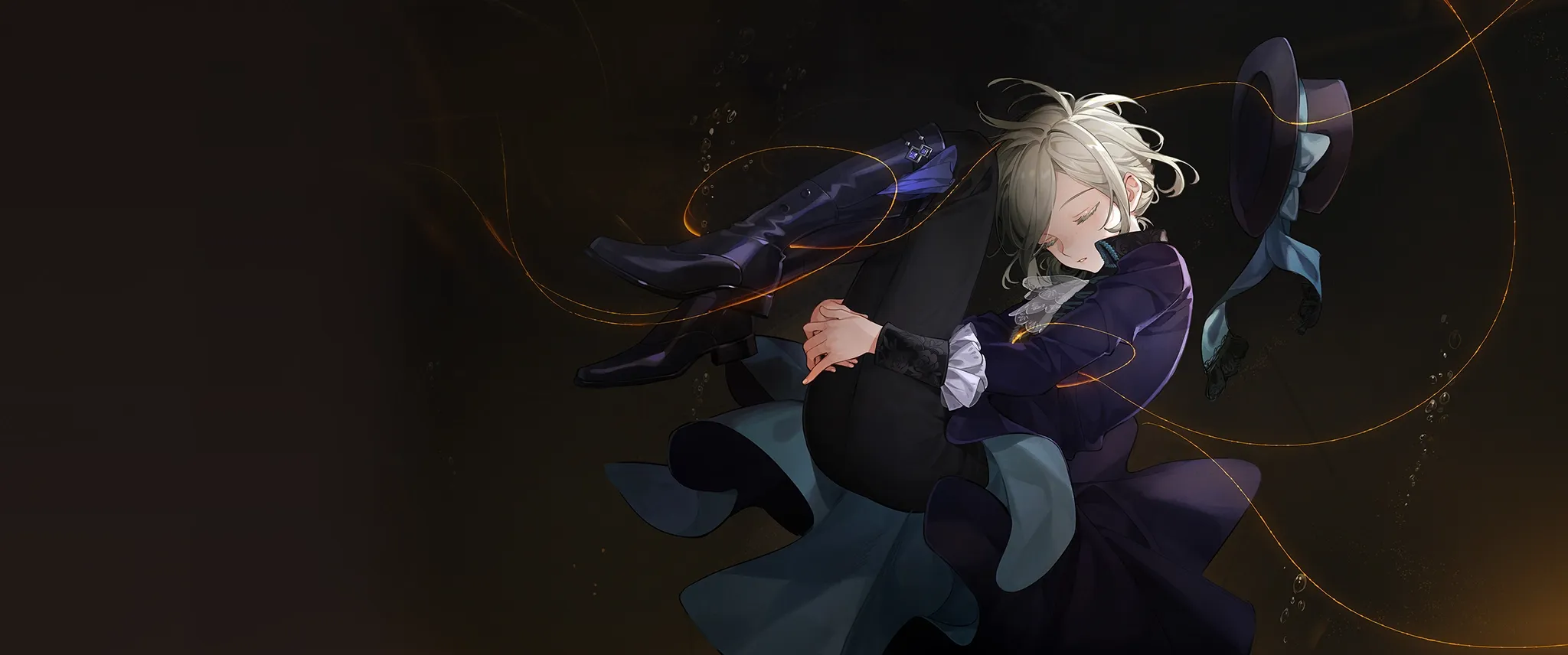
The cannon fire fades as the poison gas dissipates. They rise from the trenches, these men, not yet dead, but not quite alive.
They brush away the cinders and smoke and look out upon the world once more.
Franz: That rookie's still in shock.
Charon: Hmm ...?
Franz: Looks like you haven't snapped out of it either ... Still can't tell if you're just slow or off in your own little world.
Franz: Watch your step. Fall into a shell hole and you'll regret it fast.
Franz: ... Not that you need the reminder. We've been through this palaver before.
As he talks, the soldier snaps off the lower half of his comrade's dog tag before carefully lowering the helmet over his face.
Charon: He removed his mask, even with gas hanging heavy in the shelter.
Franz: Typical rookie mistake.
Franz: Better not to trust your gut to tell you what's safe and what's not when you're so green.
Franz: They want the cursed gas gone so badly that they lie to themselves and just pull the things off before it's gone. Now look at them—can hardly recognize the Frontschweine.
Charon takes a moment to study the shadow clouding his vision.
Charon: Misery lies heavy on you.
Franz: Ha! If I could still feel misery, do you think I'd be standing here right now?
Charon: ... In the trenches, feelings fade until only the will to endure remains.
Charon: Will you say a prayer for him?
Franz: Isn't that your job?
Charon: There is no faith in me, but if a prayer can ease their pain, one will be offered.
Franz: Alright, alright. You go check on the poor bastards over there. This kid's from my hometown. I'll take care of him.
The soldier straightens up before his fallen townsman, as if trying to shake off his informal demeanor.
Charon studies him a moment longer, then turns and rolls his makeshift cart forward.
Soldier I: Heh ... Charon, wherever death goes, you follow right behind.
The bags of dog tags in their hands jingle as the soldiers give him terse nods.
Soldier II: Franz must be cut up. That boy ... he was his teacher's kid—like a younger brother to him.
Soldier I: He trained those rookies every damn day. Taught them how to spot the whistle of a shell, how to time a grenade to the second ...
Charon: When fear knocks on the door ... training often disappears.
Soldier I: Well, he did his best. That's all any of us can do.
Charon says no more. With the tag removed, he turns to examine the fallen soldier's barely attached arm.
The soldiers move the body in the same way they always do, by the head and feet, up then down. The cart creaks beneath the weight.
Soldier II: Shoot ... another goodbye.
The soldiers curse and grumble, but Charon's gaze remains fixed on the patch of mud ahead.
A crumpled triangle of black and white sticks out from the mud.
It quivers in the wind, like a fallen petal.
Soldier I: Charon?
Soldier II: I honestly still can't tell if he's daydreaming or just slow in the head.
Charon steps forward and slowly pulls it from the mud.
Soldier II: Hang on, what's this?
A world apart from all this—the mud, the smoke, the shelling, the suffering, and death.
A woman with neatly parted hair holds a bouquet of fresh cornflowers in her arms.
She smiles a tender smile, an unspoken longing hidden somewhere behind her eyes.
Soldier II: Oh? Who's this, then?
Soldier I: I bet she's his wife ... or, uh, maybe his sister? His mother?
Charon: Then where is her husband, her brother, or her son?
Charon: Might any of you know who this photograph once belonged to?
Soldier I: I can tell you right now, he's not from our company.
Charon: Then those elsewhere must be asked.
Charon opens his notebook and slides the photograph between its pages.
Unrest ripples through the nearby crowd.
Franz: Charon! Get over here and give us a hand!
Franz: We've got a wounded man and no way to move him. We need you, Charon! Get him to the field hospital!
A soldier pats Charon on the shoulder. He turns, quietly following Franz's summons.
Charon: Jawohl. He will be delivered.
The moment Charon crosses the field hospital's threshold, a pair of eyes locks on him.
Only once the nurses take the wounded soldier does the watcher step forward to speak.
Lieutenant Colonel Wolker: You're Charon, Eberhard's officer. Is that right?
Charon: Yes, sir.
Lieutenant Colonel Wolker: You're a curious sort, aren't you?
Lieutenant Colonel Wolker: A man returns from death itself, then refuses honors and turns down the press bureau.
Lieutenant Colonel Wolker: Did you come to the front just to ferry the wounded and bury the dead?
Charon: ...
Lieutenant Colonel Wolker: Not the talkative type, I see. Little wonder you turned down the press.
Charon: Officers of your rank generally disapprove of reluctance to work with the press bureau.
Lieutenant Colonel Wolker: Hah! Not at all.
Lieutenant Colonel Wolker: Stories of heroism, steel-hearted youths—this is the stuff that sends schoolboys off to die.
Lieutenant Colonel Wolker: They marched off, grand images of Odysseus's voyage in their minds, only to find themselves cast in a tale far crueler than they could ever have conceived.
Lieutenant Colonel Wolker: You follow your own form of heroism, regardless of what "we" stand for.
Lieutenant Colonel Wolker: Some might call you strange, but me—I respect you. I'd like to understand you.
Charon: ... You are mistaken, Herr Oberstleutnant. There is no ideology behind the actions of the dead.
Charon: Only exhaustion. That is all.
A moment passes in silence. The lieutenant colonel's gaze stretches outward, fixed on some unseen, unnamed horizon.
Lieutenant Colonel Wolker: You're an honest man.
Charon: Lying simply serves me no purpose.
Lieutenant Colonel Wolker: Four days from now, this field hospital will be packed up and sent to the rear. This is likely to become the front line.
Lieutenant Colonel Wolker: When that time comes, many dead and wounded will be left behind.
Charon: They will be laid to rest with dignity.
Lieutenant Colonel Wolker: You've grown accustomed to the helplessness of war, it seems—even to this kind of cruel abandonment.
Charon: There are no words, neither angered or reasoned, that can be said to change things.
Though brief, the conversation only adds to the burden weighing heavily on both their shoulders. After a pause, the lieutenant colonel quietly moves to depart.
Lieutenant Colonel Wolker: I have duties to attend to. I believe we'll cross paths again.
Charon: Farewell, Herr Oberstleutnant.
Like a gear locking into place, Charon moves to his next task: retrieving the notebook he set down just ten minutes earlier.
With a step and a turn, he retraces his path to where the soldier was lifted onto the stretcher.
In his narrow field of view, he catches sight of his notebook cradled in a pair of trembling hands.
Charon: ...!
Its holder looks up. Her expression holds no hint of remorse for handling something so personal.
???: Is this your notebook?
Charon: ... It is.
???: This butterfly pattern is lovely. Do you collect butterflies?
Charon: ...
Charon says nothing, but the woman doesn't seem to mind.
???: I've got these two friends I've known for almost twenty years—long enough that we can't even remember when we first met.
???: We lost our parents young, my brother and I, so those friends were the closest thing we had to family.
???: One of them became my fiancé—Walter was his name. He died on the battlefield.
???: The other loved collecting butterflies. Walter and I used to sit under the stairs at his house waiting for him to show us.
???: He'd bring out his specimens, face lit up like anything as he explained them to us. Those were the only times he seemed truly happy.
???: I'd been sure he died out there too ... but then I heard these ridiculous rumors that he'd come back to life.
She glances his way, her eyes a piercing blue.
???: I didn't believe it at the time. But now ... I suppose I have no choice.
Charon: ... Partita.
Partita: Paul ... why didn't you come home?