

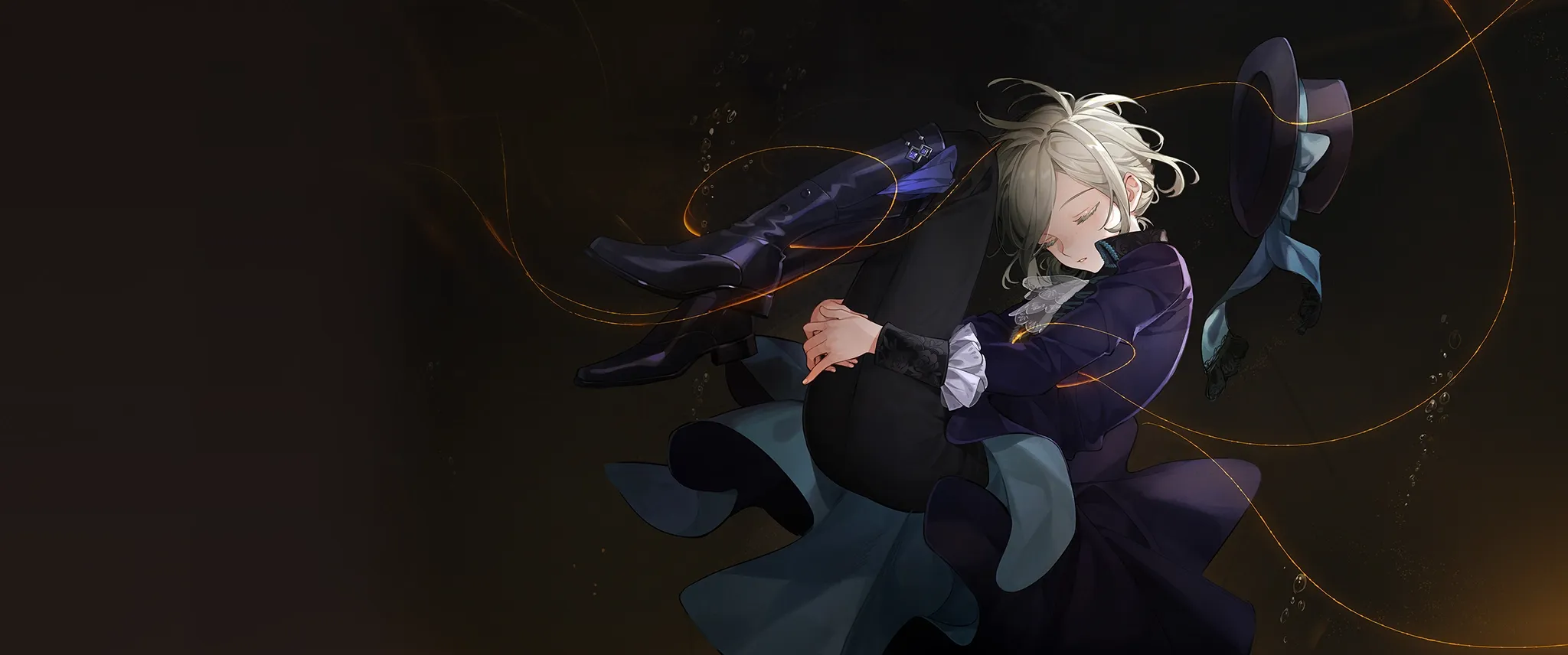
I see what lies behind the words.
Knowledge flows from the minds of those who came before to the tips of their pens, then is inked across pages, bound into books, and preserved for the future.
This is much like the fate of 6. only that I inherit wisdom from others in a different way.
When you gaze at it, it no longer has a complete form. "Wisdom" is a name forcibly given — it is actually a collection of the complex thoughts of the human species.
I drink merrily with mountain thieves, I voyage with heroes, I invite the wise to my side and debate with them.
I read from books as if I were peering into the thoughts of someone else's mind.
Gradually holding these thoughts in my palm, I realize that, however complex their curves may be, they only have two ends.
At one end is "life," and at the other is "death."
Because this is the fate of man. We are like hemp on a spindle, a finite collection despite all our variations.
The world is destined for strife, misfortune, and calamity. The good are not always rewarded for their virtues, nor are the wicked always punished for their sins.
In the end, everything just happens, as purposeless as the pebbles washed up on a beach.
Atticus: ...
Atticus: Is this all there is?
That night was darker than usual; even the shimmering sea was engulfed by the inky blackness. I felt the sand under my feet slipping away, and I, in my totality, started to float away with it.
All color faded, and I was suspended in an empty, black space.
That day, Alma wanted to see me. I closed the "Nothingness of Being" and left my room for the first time after a long retreat.
I return to the roofed home and climb up the slope, away from the sea's embrace.
Alma grabs my hand. She's heard of my recent struggles and worries that I am falling into the void of knowledge.
I guess every word before she speaks—6's wisdom, the ancient maxims, the advice of "The Golden Verses"—I've heard them all endlessly.
I don't blame her, this is the 6's duty, her destiny.
I brush her hand away and return to my own battlefield.
Even if knowledge leads to void, I need to use it to confront that unknown "revelation."
210: —!
Someone stops me. It's 210. I hear him speak with intense emotion about "the revelation".
Atticus: The revelation is a curse, my friend.
I shouldn't have answered, for this is not his fate. He always tries to meddle in matters far beyond his abilities, which only brings disaster upon himself and others.
Cautious Daedalus and proud Icarus both fitted themselves with wings and attempted to fly over the sea.
The former landed safely at a low altitude, while the latter flew too close to the sun, only to fall from the sky under its wax-melting heat.
It's not hard to see the one he more closely resembles.
37: ... ?
Someone enters my retreat. It's 37. She's always curious, always puzzling and questioning.
Fortunately, she also always firmly believes she is right.
Atticus: ... Sorry, 37. I can't help you with this right now.
In truth I can answer her; my own questions earlier were as much or more profound than hers.
And perhaps I could offer many wise answers, but they might do her more harm than good.
The sea nymph Thetis dipped her son Achilles in the River Styx, granting him immortality.
To keep her baby from being swept away by the strong current, the mother held onto him by the heel. Her love made Achilles' heel his one fatal weakness.
It's not hard to see where 37's own weaknesses lie. At the very least, I shouldn't reveal them prematurely.
I close the door again and sit in silence.
And who am I? To which fable do I belong?
Yes, I know that too.
—Oedipus went through his struggles and met his prophesied doom. Thus, the perfect tragedy came into being.
Everything is crystal clear.
Atticus: ... Now I know it all.
Atticus: But what do I do next?